
Liquid hydrogen for high-performance drones

Hydrogen, especially green hydrogen, has become synonymous with decarbonisation and the energy transition.
Whilst hydrogen is certainly a powerful tool in the toolbox for a net-zero future, this focus has diverted attention from the unique properties hydrogen offers. There are certain properties that hydrogen, whether it be grey, blue or green, offers as a high-performance fuel. These characteristics put it in a class of its own.
Vertical take-off and landing (VTOL) drones are becoming ubiquitous in civilian, industrial and defence applications. Perhaps more than any other application, it can benefit from the unique properties that liquid hydrogen has to offer as a high-performance fuel.
Liquid hydrogen is unique
The gravimetric energy density of pure hydrogen is three times that of methane or aviation kerosene Jet fuel. Whilst these hydrocarbons win on volumetric energy density, in aviation and aerospace applications, where high-performance drones are used, the challenge is to conquer gravity. In this respect, hydrogen is the stand-out choice.
Hydrogen has advantages over other fuels and liquid hydrogen offers advantages over compressed gaseous hydrogen. Liquid hydrogen and gaseous hydrogen have the same gravimetric energy density, but liquid hydrogen has a volumetric energy density of almost three times that of compressed gaseous hydrogen at 350 bar, and almost twice that of compressed gaseous hydrogen at 700 bar.
Liquid hydrogen occupying a small volume enables a smaller drone, which means a profile with less drag. Less drag means much less energy, or fuel, is consumed during flight.
Systems built from components
The mass and volume of fuel is relevant, but the integrated fuel storage, refuelling and fuel delivery system must be considered to fully compare fuel types. The term gravimetric index (GI) is commonly used to represent the mass of fuel compared to the mass of a component or system. It is also referred to as the ‘yield’.
The GI for a liquid hydrogen tank, when considering the vessel only, can be in the order of 30%. When the pressure regulation device, shut off valve, pressure relief valve and pressure raising circuit is included, the GI falls to around 25%. Then, when adding the liquid hydrogen vaporiser to warm the hydrogen up to the fuel cell feed temperature, the GI of the entire system might be close to 20%.
When comparing fuel storage systems it is relevant to ensure that like-for-like comparisons are made between components, or systems. A clear definition of the boundary enables fair assessment.
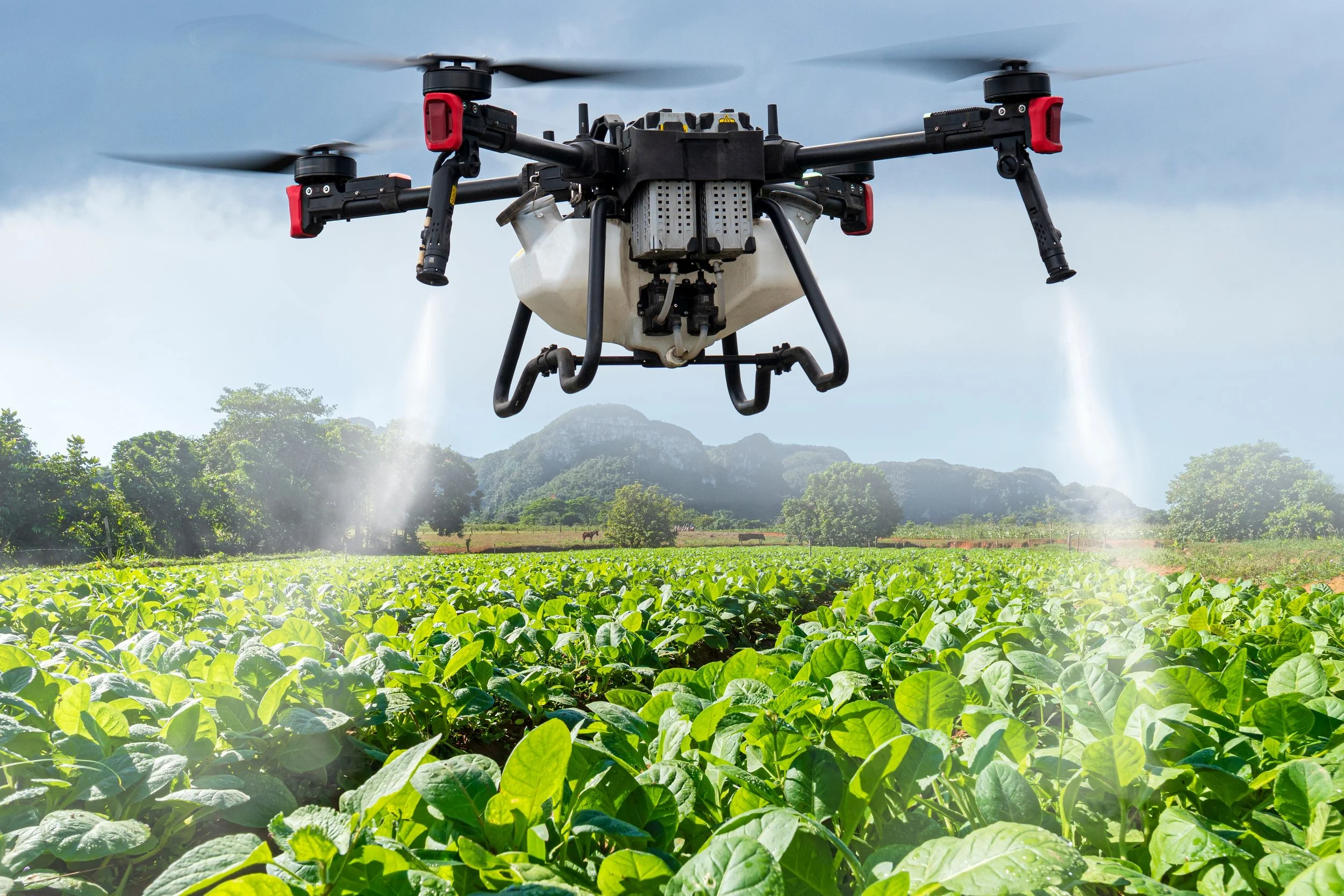
Image Credit: Melnikov Dmitriy/Shutterstock. Used with permission via sbh4 GmbH.
It’s all about performance
Storing more energy on board by using liquid hydrogen as a fuel unlocks a triad of performance benefits.
Speed: Faster flight consumes more energy. Not just a little, but a lot! In cruise, the energy (E) requirement of the fuel in a fixed-wing drone increases proportional to the square of the velocity (v). E ∝ v2. Achieving the same range in a shorter time means carrying more energy in the fuel tanks. Liquid hydrogen enables speed.
Range: Longer duration missions consume more energy. And they need more fuel on board to provide the energy, meaning at take-off a lot of energy is expended lifting fuel. The implication is that the fuel energy requirement is exponentially proportional to range, in broad terms, P ∝ d1.1. Catapult launch can help to mitigate this for lighter drones. But broadly speaking, range either means carrying a heavier mass of fuel, or upgrading to a fuel with a higher energy density. Liquid hydrogen has an unbeatable energy density.
Payload: Heavier payloads mean more energy is required to combat gravity during the take-off and climb sections of the mission. Again, this can be mitigated for some drones using catapult launch. However, after the climb, there must still be energy left to achieve the required range. Liquid hydrogen packs enough energy into the tank to enable a high maximum take-off weight (MTOW) and a long-range flight. Again, this is an exponential relationship: for a VTOL multi-rotor hover drone, P ∝ MTOW1.5.
More energy means fewer drones
Using liquid hydrogen as an energy-dense fuel significantly reduces the cost of the drone fleet.
Faster drones get to and from their objective location sooner. This is critical in applications where one or more drones are in continuous operation, such as a fleet of logistics drones. Higher speed means fewer drones are required to perform the required missions or deliveries.
Longer range means that fewer drones are required for continuous surveillance of a remote location. Consider the case that it takes a drone 2 hours to fly to its destination and another 2 hours to return to base. If the fuel energy is sufficient for 5 hours of flying time, only 1 hour is available for surveillance at the destination location.

For permanent monitoring of the remote location in this case, a minimum of five drones are required. And this assumes zero refuelling time! Add the refuelling time, and the fleet size grows to 6 or 7 drones.
Upgrading the fuel to liquid hydrogen to increase the range significantly reduces the number of drones required. Using 1kg of liquid hydrogen, rather than 1 kg of aviation kerosene, would approximately triple the range of the drone, meaning it has 12 hours of flying time. With the same 4 hours required for outbound and inbound flight, the liquid hydrogen drone can spend 8 hours at the reconnaissance site.
Using liquid hydrogen means that only 2 drones are required to perform the continuous surveillance mission. One drone is at the remote location for 8 hours. The other is returning from the location, being refuelled and flying back out to the location during this 8 hour period. The refuelling, and re-loading with any payload, can now take a luxurious 4 hours.
The drone fleet is one third the size. For high-performance drones, and especially drones carrying high value payloads, such as scientific equipment or high-cost surveillance devices this 66% saving in the capital costs can mean tens, or hundreds of millions of capex is being saved.
The above analysis can be repeated for battery powered drones, but the conclusion will be in a similar direction: a higher energy density fuel and powertrain means fewer drones are required to cover the mission.
Powertrain
When considering hydrogen as a fuel, low-temperature PEM (LTPEM) fuel cells are, in themselves, very light. However, for high performance, they require humidifiers and cooling equipment. These balance of plant items reduce the specific power of a hydrogen-fed PEM fuel cell at the system level to a range of 0.5 to 0.8 kW/kg.
This is less than a kerosene-fed internal combustion engine, which can generally achieve 1 to 1.5 kW/kg. The consequence is that an LTPEM fuel cell would be heavier than an internal combustion engine (ICE) which can be fed with kerosene. LTPEM fuel cell powertrains reduce the performance advantages of switching to hydrogen as a fuel.
On the other hand, a powertrain system using a high temperature PEM (HTPEM) fuel cell offers a power to weight ratio up to 1.2 kW/kg, competing with an internal combustion engine. The higher temperature operation of the HTPEM fuel cell means cooling equipment is lighter because the temperature differential to ambient is higher. Additionally, they do not require the humidifier equipment, which a powerful LTPEM system would need.
It should also be noted that internal combustion engines are mature with few breakthroughs on the horizon. Conversely, as emerging technologies, PEM and HTPEM fuel cells are getting lighter and more powerful year on year. It is likely that PEM will achieve a power density of 1 kW/kg will be achieved within this decade, increasing to, and potentially surpassing, 2 kW/kg during the next decade.
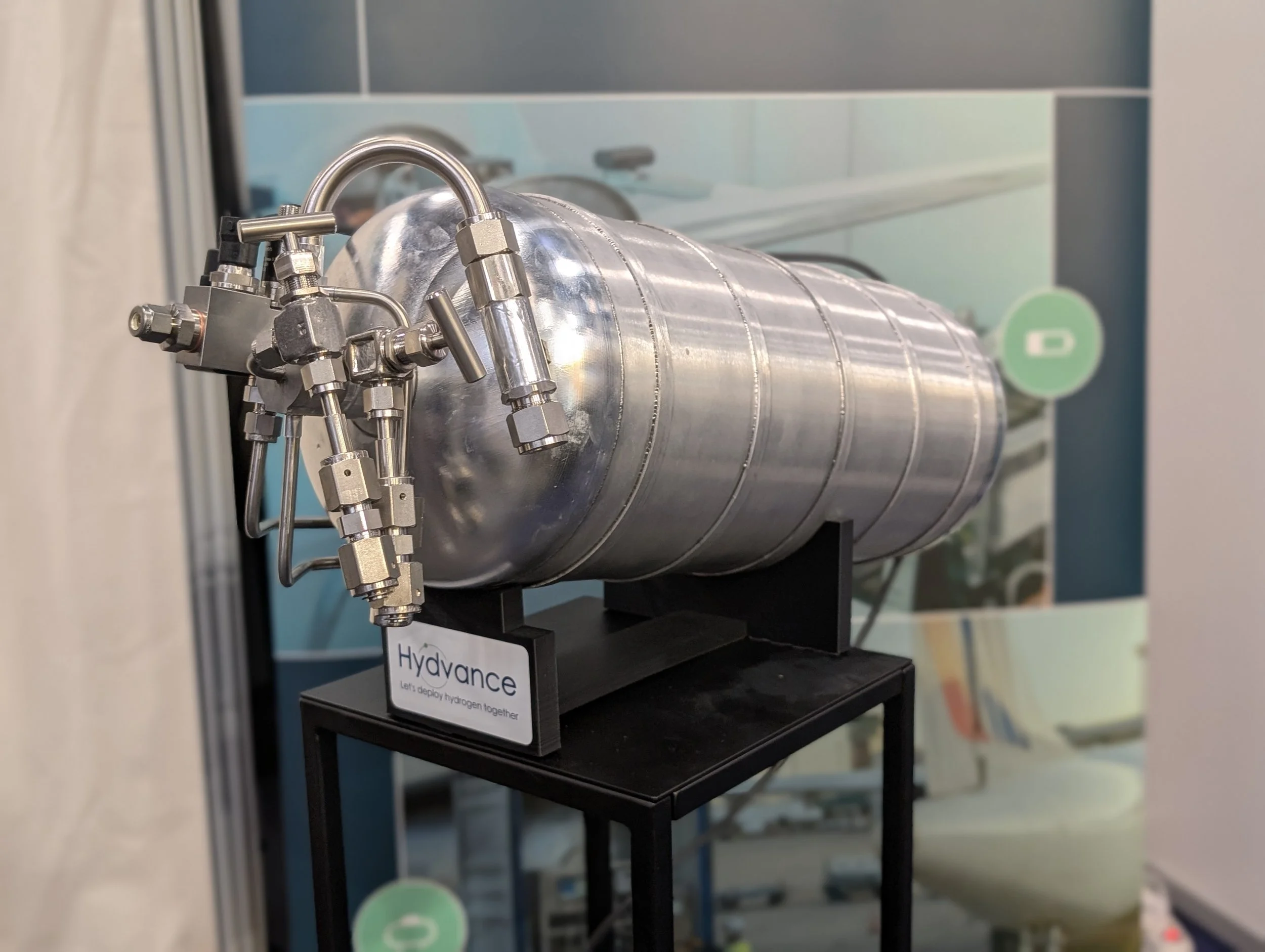
Hydvance aluminium cryogenic liquid hydrogen tank. Used with permission via sbh4 GmbH.
Fuel storage
Kerosene can be stored in a light-weight plastic tank or within the wings. In the system gravimetric index-stakes, this is perhaps the main advantage that it has over hydrogen.
Compressed hydrogen can be stored in ‘light-weight’ carbon-fibre composite tanks. However, the term ‘light-weight’ is relative. They are indeed lighter than the steel tanks they have replaced, but 700 bar carbon fibre hydrogen tanks add a lot of mass to the combined fuel and storage system.
The efficiency of a storage tank is defined by the mass of fuel, compared to the total mass of the fuel + tank system. The tank system is comprised of the tank itself plus the associated safety devices for pressure relief; equipment for hydrogen temperature and pressure conditioning to the application; re-fuelling connections; and sensors.
In the case of liquid hydrogen this mass efficiency, or fuel yield, can reach 30%. For compressed gaseous hydrogen it struggles to rise above 10%.
Achieving 30% fuel yield for liquid hydrogen means avoiding heavy materials such as steel in the construction of the tank. Aluminium is an ideal substitute for steel: High-strength aluminium alloys are commonly used to construct aircraft and the same alloys can be used to build strong, light liquid hydrogen storage tanks.
Additionally, aluminium alloys are not sensitive to hydrogen embrittlement. Furthermore it is less expensive than other high-strength materials such as fibre reinforced composites and titanium.
For land-based liquid hydrogen storage applications, a double-walled cryogenically insulated steel tank would be acceptable. In aviation and aerospace, mass matters most: aluminium is by far the better choice for VTOL drones.
***
Author credit – Stephen B. Harrison, sbh4 GmbH
sbh4 is an independent advisory firm focused on decarbonisation and defossilisation through e-fuels, e-fertilizers, biofuels, SAF, CCTUS, GHG emissions reduction, and the emerging hydrogen economy. For more information, visit www.sbh4.de.