
AM Green to establish India’s first commercial-scale green hydrogen and ammonia facility
South India is establishing itself as the focal point of green molecules, as exemplified by AM Green’s flagship green ammonia complex in Kakinada, Andhra Pradesh. Following its Final Investment Decision (FID) in August 2024, the project has entered its execution phase, positioning itself as India’s first commercial-scale green hydrogen and ammonia facility.
At the heart of the development is a bold transformation. AM Green is repurposing the former Nagarjuna Fertilizers grey ammonia complex and replacing steam methane reforming of natural gas with electrolytic green hydrogen production.
From grey to green
Grey ammonia production from natural gas reforming is responsible for a similar amount of CO2 emissions as the global aviation sector: the transition to green ammonia will have a significant positive impact on global decarbonisation.
The existing grey ammonia plant, which was slated for shutdown due to uncertainty around natural gas supply, is being converted to run on electrolytic green hydrogen, preserving around 500 direct jobs and breathing new life into this ammonia production asset.
Around 85% of India’s ammonia use relies on imports. Madhura Joshi, Programme Lead - Asia Hub, Global Clean Power Diplomacy at E3G, based in India says that “India imports thousands of tonnes of grey ammonia each year to support local agriculture and feed the nation.”
“The production of green ammonia locally,” continues Joshi, “will be a tremendous win for balancing international trade and ensuring food security. Development of the first wave of projects at commercial scale is essential to drive this sector forward.”
The Kakinada facility is being built in phases to reach truly world-scale capacity. Phase 1 will deliver 0.5 million tonnes per annum (MTPA) of green ammonia by late 2027, progressing toward 1 MTPA in its full configuration.

AM Green Ammonia plant location and port at Kakinada. ©AM Green
Hydrogen at its heart
AM Green is pursuing a 5 MTPA green ammonia production target by 2030. This requires circa 1 MTPA of green hydrogen, representing 20% of India’s green hydrogen production target under its ‘National Green Hydrogen Mission’.
This places the Kakinada project among the largest green ammonia developments globally, and one that will become increasingly influential in shaping international clean molecule trade.
Hydrogen will be produced on 1.28 GW of pressurised alkaline electrolysers supplied by John Cockerill. These electrolysers are configured in 5 MW stacks, each producing roughly 100 Nm³/hr. In total, this equates to approximately 545 tonnes of electrolytic hydrogen per day.
A total of 128 stacks will be installed in the first 640 MW phase, with the first 20 MW block being commissioned in Q1 and mechanical completion targeted for late 2027.
To make ammonia, hydrogen is combined with nitrogen which is produced by two on-site cryogenic air separation units which will also be fed with renewable electricity. Ammonia is produced in two trains which will be refurbished by Casale and Rely.
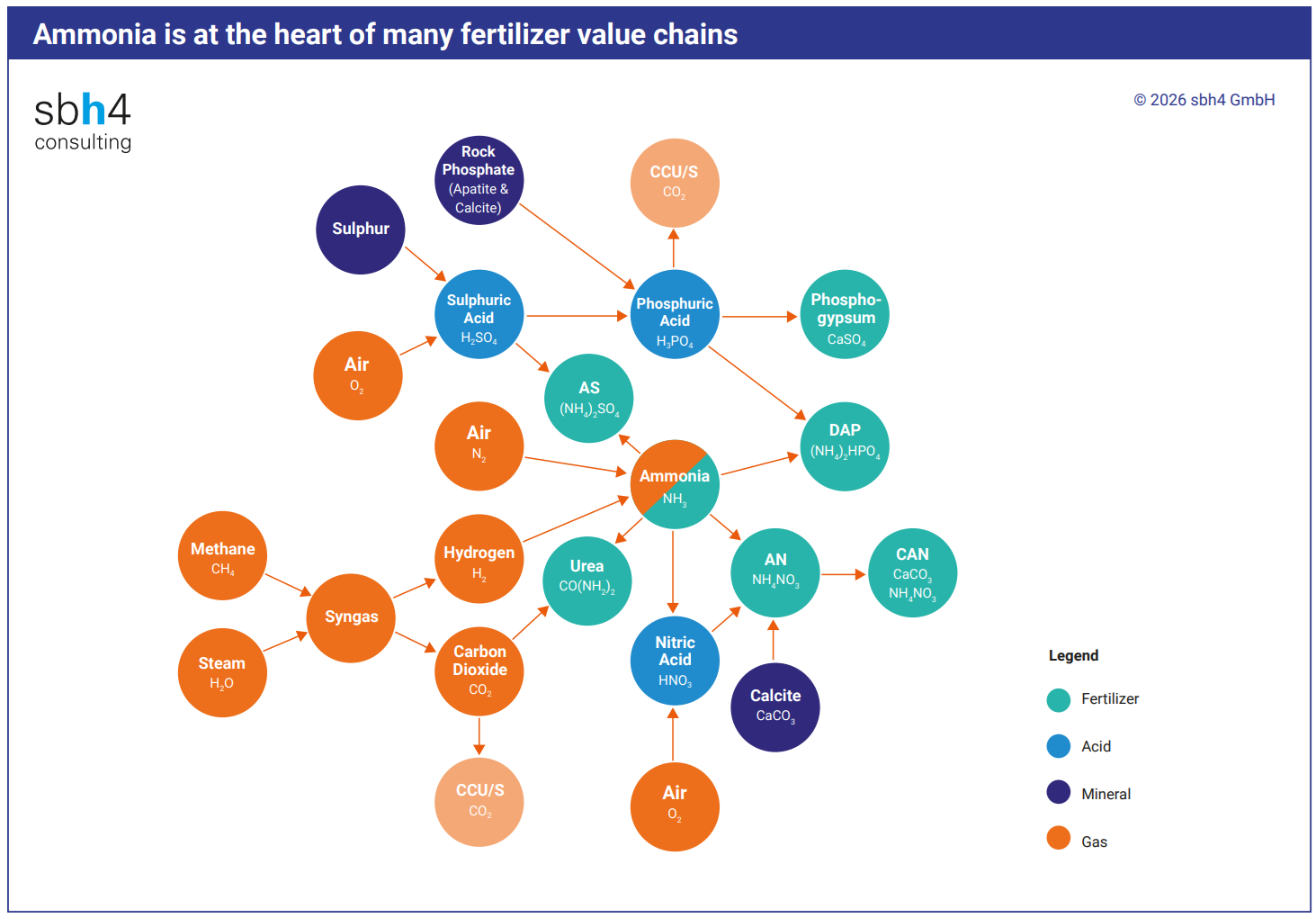
Firm renewable power supply
A key advantage underpinning the project’s competitiveness lies in India’s integrated power system. The “One Nation, One Grid, One Frequency” policy allows renewable electricity from resource‑rich regions, including solar, wind and pumped hydro generation, to be transmitted to electrolytic hydrogen production sites with firm round-the-clock (RTC) supply.
AM Green has secured 1,300 MW of RTC carbon-free power, enabled by 4,500 MW of hybrid wind and solar assets and 950 MW of pumped storage capacity. Additional renewable power will be used to generate the green ammonia. Construction of new clean electricity generation capacity from wind and solar generation will displace fossil fuels.
According to Joshi, “in support of renewable power generation, India has successfully scaled up local PV solar module manufacturing, reaching around 144GW per annum. This capacity is now sufficient to meet domestic demand and allows significant room for exports.”
Greenko Group is developing a 1,680 MW pumped hydro storage plant at Pinnapuram in the Kurnool district of Andhra Pradesh. Integration of programmable pumped hydro with wind and solar avoids wasteful electricity curtailment, meaning more of the electrons which are produced by installed infrastructure can be used beneficially.
Certified green for international impact
Additional renewable electricity supply is central to achieving the EU RFNBO criteria, for which the project has already obtained pre-certification from Hinicio under the CertifHy scheme.
With EU RFNBO certification, the Kakinada facility is ideally placed to support international climate targets. Approximately 75% of the ammonia output will be exported, with the balance serving India’s domestic fertilizer sector which is heavily reliant on grey ammonia imports for food‑security needs.
AM Green has secured a robust international offtake pipeline, including a binding agreement with Uniper (up to 500,000 tonnes per year starting in 2028) and term sheets with RWE, Yara and Keppel.
This intersection of industrial repurposing, export‑led growth, and renewable energy scaling marks Kakinada as a blueprint for decarbonisation of heavy industry and the energy sector. As the green ammonia value chain is proven at scale with the first wave of projects replication in the coming decades will have significant beneficial climate impact.
CBAM makes the case
On January 27, 2026, the EU and India closed a comprehensive Free Trade Agreement. It eliminates duties on more than 95% of trade in each direction. Connecting 2 billion people, it reduces trade barriers and deepens intercontinental economic ties.
Despite this agreement, the EU will still apply the Carbon Border Adjustment Mechanism (CBAM) to ammonia imports which is a tariff based on the CO2 intensity of imports. For green ammonia, the CO2 intensity is zero meaning it is effectively exempted from this import duty.
CBAM provides a competitive advantage to green ammonia over grey. AM Green is able to exploit this because their 495 acre site is strategically located at Kakinada’s deep-water port.
Stefan Sipka, Senior Policy Analyst and Head of Sustainable Prosperity for Europe Programme at the European Policy Centre, based in Brussels says “the introduction of the CBAM rules in the EU is designed to encourage decarbonisation in countries that trade with EU nations so that there is a wide international accountability for mitigating the effects of climate change.”
“Additionally,” he adds, “it helps to level the playing field in terms of the additional cost of making green molecules.”
There have been reactions from farming communities in some EU nations related to the import of ammonia, which is used to make fertilisers. They are concerned that if costs of commodities increase due to CBAM rules, their costs of food production will rise and their competitiveness and livelihoods will be threatened. Additionally, the MERCOSUR trade agreement has received attention for similar reasons.
“Consultation with multiple EU nations and stakeholder groups is essential during policy development” declares Sipka. “Furthermore, measured reactions to valid concerns that are raised when the impact of policies become clearly understood should also be considered in good faith.
“Long term investment decisions and multi-year trade contracts rely on policy certainty. However, the world is dynamic and some degree of policy evolution is also to be expected while staying true to the overall climate ambition.”

Investable project development
AM Green’s concept leans on many best practices for investable project development: brownfield conversion reduces capex, grid-supplied firm renewable power minimise operating costs, and strategic offtake agreements secure long-term revenue visibility and bankability.
Joshi believes that “the lessons from early projects, such as AM Green’s scheme in Kakinada, will de-risk replication, introduce tangible economies of scale and lead to greater bankability of future projects. Development of these execution and technical capabilities offer the tremendous benefits of: improved supply security; increased savings by reducing imports; and supporting decarbonisation of fertiliser production in the future.”
With construction underway and commissioning beginning in 2027, the Kakinada project represents one of the most advanced examples of large-scale, green ammonia manufacturing worldwide.
“Overall, I am convinced that green ammonia production in India for export is a win-win-win for building capability to support India’s social, industrial and economic development, international trade, and the climate,” continues Joshi. “AM Green’s export-oriented project is undoubtedly net-positive for India.”
Guiding beacon
As global industries seek low‑carbon feedstocks and fuels, AM Green’s Kakinada complex is poised to influence both supply chain economics and decarbonisation pathways. It is a beacon demonstrating how Indian innovation can meet stringent international climate standards, while catalysing industrial rejuvenation.
***
Author credit – Stephen B. Harrison, sbh4 consulting.
sbh4 is an independent advisory firm focused on decarbonisation and defossilisation through e-fuels, e-fertilizers, biofuels, SAF, CCTUS, GHG emissions reduction, and the emerging hydrogen economy. For more information, visit www.sbh4.de.
Acknowledgement
This article has been prepared as part of the India–Germany Climate and Energy Journalism Programme. This programme has been organised by Clean Energy Wire in collaboration with Indian newsroom The Migration Story, with the support of the Heinrich Böll Foundation. Additionally, the author would like to acknowledge collaboration with his journalistic partner in India, Mr Jitendra Choubey.