
Turning intermittent renewables into dispatchable energy with loss-free liquid hydrogen storage
Solar and wind generation are inherently variable. Output rises and falls with weather and the time of day, often misaligned with demand. Without long-duration storage, excess renewable electricity is curtailed or wasted.
When surplus renewable power is converted into hydrogen via electrolysis and stored efficiently as liquid hydrogen (LH2), it becomes a controllable energy reserve. If the hydrogen is preserved without boil-off or venting losses, it can be dispatched when needed—hours, days, or even weeks later.
Loss-free LH2 storage transforms intermittent renewables into reliable infrastructure assets.
Enabling true long-duration energy storage
Most battery technologies are optimised for short-duration applications — from minutes to several hours. Grid resilience, seasonal balancing, and industrial continuity require longer time horizons.
Hydrogen offers a fundamentally different storage profile. As a molecular energy carrier, it can be stored at scale and reconverted into power or used directly as fuel. Eliminating storage losses ensures that energy produced during peak generation remains available during extended periods of energy shortages.
In regions with high renewable penetration, this capability supports grid stability and reduces reliance on fossil-based backup generation.
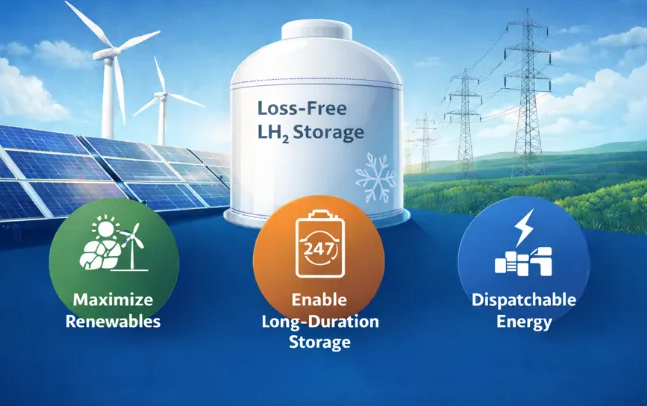
Image ©GenH2
Improving infrastructure economics
At infrastructure scale, retained energy equals retained value. When storage losses are minimised, system efficiency improves across the entire value chain:
More predictable inventory management
Reduced need for overproduction to offset losses
Lower operational complexity
Improved long-term asset utilisation
For investors, operators, and policymakers, efficiency at scale directly influences deployment decisions.
Supporting hard-to-electrify sectors
Hydrogen is increasingly seen as essential for sectors that cannot be easily electrified—such as heavy industry, maritime shipping, aviation, and long-haul transport. These applications depend on reliable fuel availability.
Loss-free liquid hydrogen storage enhances supply certainty, enabling hydrogen to serve as a practical, scalable energy carrier rather than a niche solution.
From storage to system integration
When hydrogen can be stored without degradation or venting losses, it becomes more than backup—it becomes a strategic energy reserve. Utilities can plan with greater confidence. Industrial operators can integrate hydrogen into continuous processes. Energy systems can be designed for reliability rather than compromise.
In this way, loss-free LH2 storage supports a broader shift: from pilot projects to integrated clean energy ecosystems.

Looking ahead
Producing clean hydrogen is only part of the equation. Efficient retention unlocks its full potential.
As renewable generation expands and long-duration storage becomes essential, loss-free liquid hydrogen storage enables dispatchability, resilience, and scalability. It strengthens the link between intermittent supply and continuous demand—helping turn clean energy ambition into operational reality.
***
Author credit - GenH2
GenH2 is a leading hydrogen infrastructure company based on decades of experience researching, engineering, and producing technology solutions necessary for the hydrogen economy. Leveraging years of collaboration with top hydrogen experts, the company focuses on the commercialisation of clean hydrogen liquefaction, storage, transfer and dispensing.
GenH2 participates in the advancement of liquid hydrogen infrastructure by contributing engineering insight and industry perspective. This article is intended to support informed discussion around hydrogen storage challenges and opportunities as the energy transition accelerates.
For more information, visit www.genh2.com.