
New white paper suggests decoupled water electrolysis could help to achieve cost parity green hydrogen
In a volatile era, green hydrogen is emerging as a key enabler of energy resilience but the challenge is to deliver it at a competitive price.
Renewable electricity is now abundant and low-cost, yet green hydrogen remains prohibitively expensive. H2Pro explore this paradox in a new white paper just released, explaining that while electricity accounts for about 60 to 80% of hydrogen production cost, falling power prices have not translated into lower levelised cost of hydrogen (LCOH).
The lowest-cost electricity is inherently intermittent – solar, wind, curtailed power – requiring operation under frequent on/off cycling and fluctuating power loads.
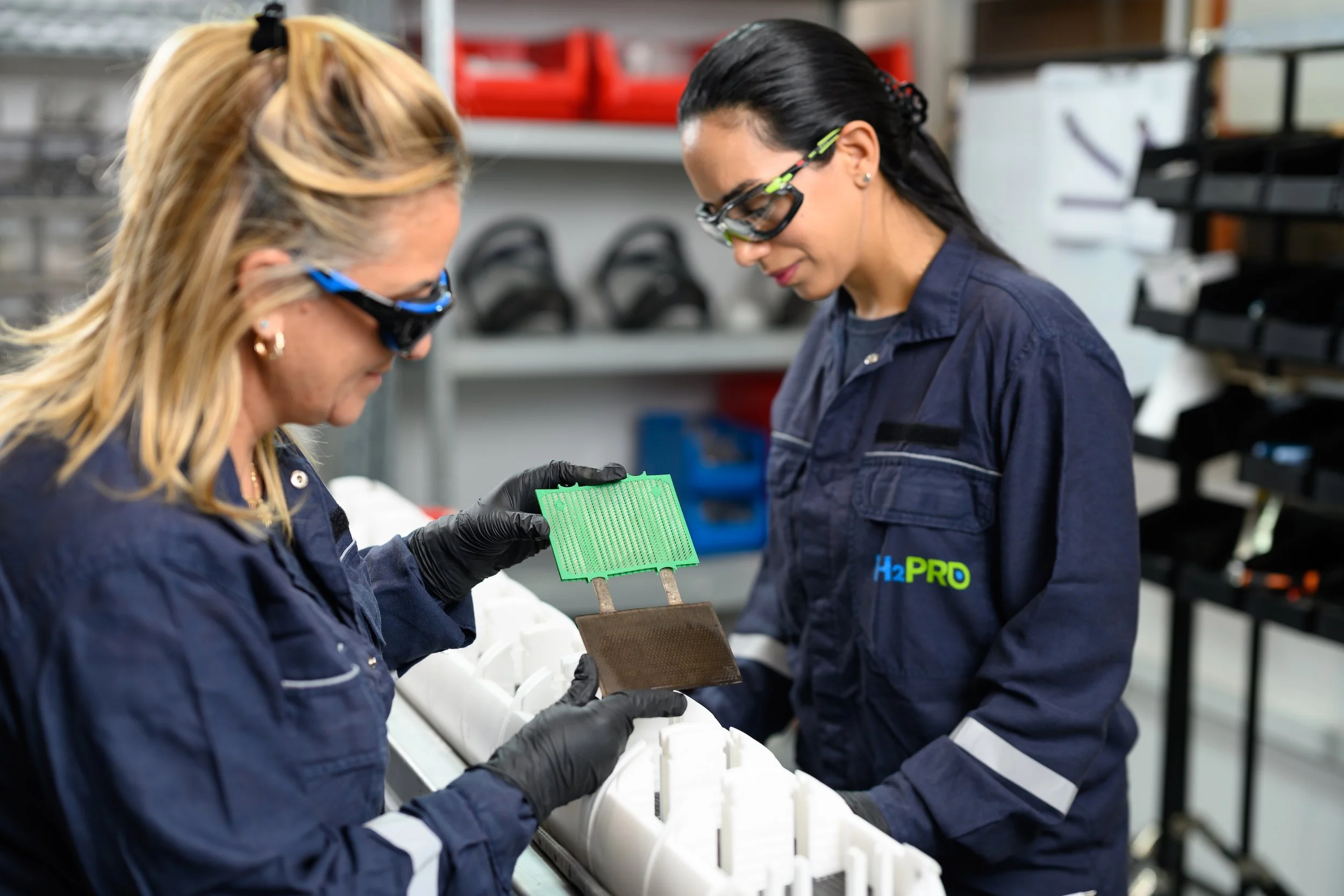
Image ©H2Pro
The new white paper suggests that the core barrier to cost-parity green hydrogen is not access to cheap electricity, but the inability of electrolysers to utilise it without significant technology challenges.
H2Pro maintain that conventional electrolysers are designed for stable baseload electricity. Due to inherent engineering limitations, they can often struggle under intermittency.
Dr Hen Dotan , CTO and CoFounder at H2Pro, said: “Under variable load, alkaline water electrolysers (AWE) suffer from shunt current losses and gas crossover, severely reducing efficiency and limiting safe operation at low loads.
“Proton exchange membrane (PEM) electrolysers can follow load, but incur accelerated catalyst degradation (Ir/Pt dissolution) and membrane degradation (ROS-driven thinning), shortening system lifetime.

“Under repeated on/off cycling, AWE systems experience reverse-current-driven electrode corrosion, rapidly degrading performance. PEM technology suffers from small gas crossover during idle periods; unlike during normal operation, these gases are not swept away and can accumulate during shutdown, accelerating corrosion of both the electrocatalysts and the membrane.”
H2Pro examine these issues in-depth within their extensive white paper, offering unique insight and a credible solution to achieving cost parity green hydrogen through an innovation known as decoupled water electrolysis (DWE).